The Growth Trap—Why Businesses Must Respect Planetary Boundaries
Article · 7 min read · October 01, 2023
By Olivier Maréchal
In our modern society, growth equals progress. This equation lies at the core of how we understand business success and economic prosperity. It's the driving force behind what we proudly call advancement—the creative destruction that economist Joseph Schumpeter identified as essential to innovation.
But here's what business leaders must confront: the unobstructed view of what lies ahead when growth meets its natural limits.
The Maturity Paradox
In nature, nothing grows forever. Trees don't reach the stratosphere. Humans don't continue growing taller throughout their lives. That would be absurd.
Yet we expect the economy, businesses, to defy this fundamental law of maturity.
The most significant phase for any business isn't endless expansion—it's maturity. This critical stage gets overshadowed by the seductive idea of perpetual growth. While growth offers flexibility and abundance, it cannot be limitless. This isn't pessimism; it's physics.
Consider housing development—a political lightning rod. Leaders routinely avoid the essential question: where do the limits of growth actually lie? The illusion of boundless expansion aligns with our deeply held belief in infinite opportunity and resource abundance. A comforting but implausible reality that distorts decision-making and hampers psychological wellbeing.
The Mathematics of Constraints
Stocks and flows form the foundation of modern economies. Converting land for housing depletes the available stock of land—an almost irreversible process.
Let's be concrete: The average adult requires approximately 2700 kcal/day. With an average of six individuals fed per cropping hectare 1, the United Kingdom needs about 11 million hectares to feed its population—nearly half its land area. And the UK isn't self-sufficient, importing almost half of its food 2.
These numbers become more daunting when factoring in Net Zero commitments and COP15 biodiversity protection pledges. Land isn't just valuable—it's finite and precious, with direct implications for food security and national well-being.
In the United Kingdom, land valuation reaches £6.3 trillion, representing nearly 60% of the nation's net worth 3. Most falls under non-developed classification, yet this allocation falls short of meeting pledged environmental commitments. And there's only 1.1% land left vacant—just 268,000 hectares.
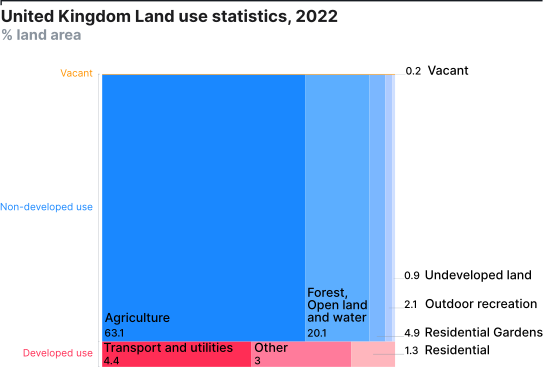
The Growth Trap
When facing these constraints, modern capitalism's response is predictable: create more runway for growth, even when the finish line is in sight. We deregulate, increase financial risk-taking, and obsessively pursue efficiency.
Economic growth isn't merely aspirational—it's necessary to sustain our credit-driven economy. So we adopt short-term tactics like reducing grazing to increase cropping, extracting more calories per hectare while ignoring long-term implications.
The current paradigm, embedded in our mental models, pushes decision makers toward solutions that appear rational today but become absurd over time and at their logical conclusion. Reducing resources essential for sustaining a population while simultaneously supporting its growing demands for prosperity is fundamentally unsustainable.
Here's the conundrum: no compelling alternatives have emerged in political discourse. The long-term implications of expansion directly conflict with the short-term imperatives of the system that powers modern societies.
The Debt-Growth Cycle
What drives policy when a country approaches its physical growth limits? Society itself demands growth. Local councils face constituents expecting better healthcare, schools, and infrastructure. Aging services lead to voter dissatisfaction—not ideal for winning elections.
A flow of investments offers brighter prospects. But there's no free lunch. Capital follows return prospects. As councils use debt to deliver services today instead of tomorrow, they need increased tax receipts to service that debt—either through higher taxes (unpopular) or more taxpayers (growth).
The result? A self-reinforcing pattern of expansion. As long as growth continues, expectations are more easily met. The catch? It cannot continue indefinitely.
Business leaders find themselves trapped in this expansion cycle, servicing debt that endangers both their enterprises and the planet. We must confront the harsh reality that our world has already breached planetary boundaries, with profound impacts on business strategy.
Blind Spots and False Solutions
Business leaders share inherent blind spots around capital investment. Consider emissions offsetting and market size overestimation—practices that perpetuate dangerous illusions and lead to misinformed decisions.
The Stockholm Resilience Centre's planetary boundaries framework emphasizes the need for Earth System Governance. These boundaries include critical processes like land-system change, climate change, biosphere integrity, and freshwater use.
Yet our prevailing model adheres to free-market principles, allowing unrestricted resource access. The real world has finite limits, even when our mental models struggle with this concept.
The concept of carbon neutrality, enabled through the augmentation of carbon sinks merely masks deeper resource constraints. A marginal increase in tree cover cannot wish away planetary limitations. Such practices encourage businesses to grow beyond sustainable boundaries, increasing systemic risks. They create the seductive illusion of unconstrained growth despite having no scientific validity.
Getting Real About Demographics
Another blind spot: overestimating market sizes while disregarding demographic shifts that predict declining world population in coming decades. Ignoring these trends leads to misaligned strategies and resource misallocation.
Will the UK population grow further? Probably. Can it double? To avoid tragedy, it should not.
These aren't isolated incidents but components of a system hurtling toward crisis. Business leaders clinging to outdated growth models steer their enterprises toward impending disaster. As the gap widens between infinite growth pursuit and finite planetary limits, the risks of economic and environmental turmoil loom larger.
The Necessary Shift
The solution demands a paradigm shift and holistic approach. Business leaders must pivot toward growth that respects planetary boundaries by integrating natural capital assets into supply chains and business ecosystems.
Natural capital forms the bedrock of economic activities. Neglecting it endangers businesses themselves, as the World Business Council for Sustainable Development asserts.
This wisdom isn't revolutionary—it's ancient. From Aristotle to Adam Smith 4, history's greatest minds recognised that natural capital underpins national wealth. These polymaths left us a legacy of insight that our modern economies have systematically failed to implement. We've inherited their wisdom but ignored their practice, creating a dangerous disconnect between what we know and what we do.
Strategic Implications
Respecting planetary boundaries requires strategic foresight and bold action—a fundamental economic transformation that recognises the value of anchoring business activities within biosphere constraints.
The challenge is immense but presents unprecedented value creation opportunities, not least by preventing value destruction. Countries investing in this transformation will secure future development. First movers may secure lasting competitive advantage given the urgency and limited experimentation scope.
At the micro-level, businesses must acknowledge that exceeding certain regional and national footprint thresholds increases vulnerability and fuels systemic risks. This isn't anti-growth—it's about anchoring sustainable value creation on healthy natural capital.
Our proprietary APres sustainable business model offers a practical solution to this complex challenge. It eliminates blindspots that plague conventional strategic thinking and facilitates the development of truly future-proof strategies. Most importantly, it anchors value creation within a virtuous cycle of natural capital maintenance—connecting profitability to planetary health.
Without acknowledging this foundation, businesses will inevitably exceed the size at which they can sustain maturity in a world facing multiple crises. Many speculate tomorrow's context will broadly align with past experiences—an increasingly risky bet.
The Road Forward
We're entering an era demanding staggering transformation—creating both unprecedented challenges and business opportunities. To thrive within planetary boundaries, we must recalibrate strategies and revise outdated mental models.
The private sector plays a vital role—not just morally, but as a strategic imperative for businesses aiming to remain relevant for future generations. Only by acknowledging and respecting planetary boundaries can businesses secure their future in an uncertain world.
Changing outdated mental models is difficult. Being aware of the cognitive biases they impose is a good starting point. The time has come to think holistically about growth, maturity, and the finite world in which we operate.
Footnotes
-
Cassidy ES, West PC, Gerber JS, Foley JA. Redefining agricultural yields: From tonnes to people nourished per hectare. Environmental Research Letters. 2013;8(3). doi:10.1088/1748-9326/8/3/034015 ↩
-
Department for Environment Food & Rural Affairs. United Kingdom Food Security Report 2021: Theme 2: UK Food Supply Sources - GOV.UK. Published 2021. Accessed October 2, 2023. https://www.gov.uk/government/statistics/united-kingdom-food-security-report-2021/united-kingdom-food-security-report-2021-theme-2-uk-food-supply-sources ↩
-
Office for National Statistics. Improving estimates of land underlying dwellings in the national balance sheet, UK - Office for National Statistics. Published 2022. Accessed October 1, 2023. https://www.ons.gov.uk/economy/nationalaccounts/uksectoraccounts/articles/improvingestimatesoflandunderlyingdwellingsinthenationalbalancesheetuk/2022 ↩
-
Smith, A. (1976) An Inquiry into the Nature and Causes of The Wealth of Nations. Edited by E. Cannan. Chicago: The University of Chicago Press. ↩