Absolute Sustainability Reporting
From arithmetic that doesn't reflect the real world to sound stewardship.
Sustainability reporting is evolving—from vague commitments to hard science. Businesses must now disclose their impacts and dependencies in absolute terms, with spatial specificity.
The Problem

Most reporting frameworks rely on eco-efficiency or relative targets, ignoring whether activities are viable within ecological thresholds. This delays real change and creates false reassurance. Specifically, most sustainability metrics suffer from three fatal flaws:
-
They measure the wrong things
- Eco-efficiency gains ≠ absolute sustainability (a 10% reduction in land use per unit of output doesn't inform on how much land should remain in a natural state in a given ecosystem).
- LCA-based methods ignore spatial thresholds ("low-impact" water use may still drain critical watersheds).
-
They incentivise harmful behaviours
- Production intensity bias rewards scaling unsustainable systems (e.g., "lower carbon per unit" fossil fuels or intensive agriculture instead of extensive systems).
- A focus on "less impact per unit of output" introduces a market failure: it gives the advantage to corporations with economies of scale, against nimble economic actors.
-
They obscure strategic choices
- Teams drown in many indicators while missing the 3 that actually constrain their license to operate.
- No existing reporting standard connects environmental pressures to biophysical limits (planetary boundaries).
Common challenges we see
Disclosure deadlines are looming
CSRD, TNFD, and TCFD requirements are piling up—but internal systems aren't designed for them.
Metrics don't map to real-world risks
LCA scores and relative impact data obscure what's actually at stake in key regions or ecosystems.
Sustainability teams lack strategic cut-through
Too many indicators, not enough insight. Leaders don't have the handful of metrics that matter.
Reporting is siloed from business decisions
Sustainability data rarely reaches board-level strategy in a form decision-makers can use.
Efficient ≠ sustainable
Many frameworks reward scale and intensity, not resilience or ecological fit—creating a hidden market failure.
Our Solution
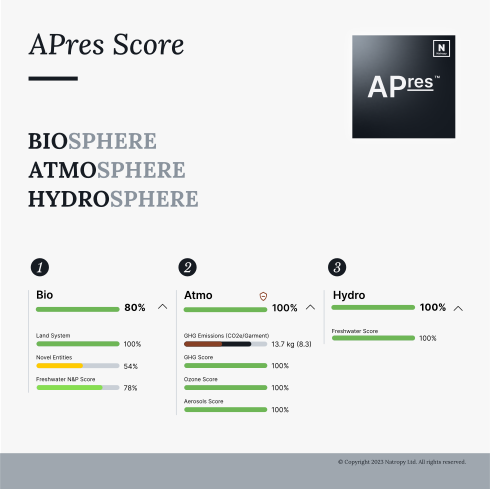
We built the APres™ Evaluation System to help firms lead the next era of disclosure. It's the first planetary-boundary-aligned reporting tool that provides a science-based view of the extent to which a firm contributes to keeping Earth systems within safe operating limits.
With it, we:
Map absolute impacts and dependencies across the biosphere, atmosphere, and hydrosphere
Align reporting with CSRD, ESRS, TCFD, and TNFD—in plain language, not compliance jargon
Replace flawed net-zero narratives with spatially explicit baselines and real thresholds, whilst effectively supporting the energy transition with an internal carbon tax
What We Measure
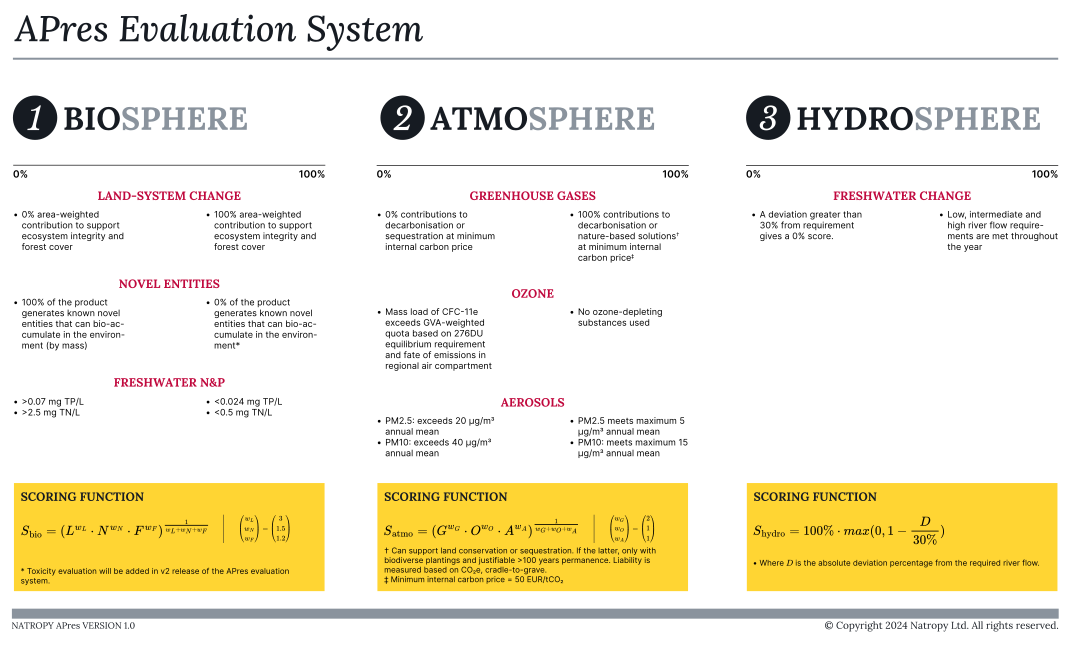
- Biosphere: Land system change, biodiversity integrity, pollutants (including novel entities), regeneration potential, freshwater nutrient pollution
- Atmosphere: Greenhouse gases, ozone, aerosols—focused on carbon integrity with no offsets smokescreens, just real fluxes
- Hydrosphere: Watershed-level water stress, river flow disruption, and nutrient pollution—never global averages

How We Support You
- Map pressures and dependencies across your operations and value chain
- Align disclosures to CSRD, ESRS, TNFD, and TCFD
- Design integrated reporting systems
- Customer-friendly reporting disclosure
A reporting system that embeds stewardship logic into your reporting. Clarity on what matters. Confidence in where you stand. A strategy for what comes next.