White paperAbsolute Sustainability2 min read
Absolute Sustainability: The APres Framework for Business
Within planetary boundaries, a business starts from what must remain of each natural stock and flow, then sizes its use to it. This paper sets out the framework that does so.
https://www.natropy.co/resources/publications/absolute-sustainability-the-apres-framework-for-business · 1 October 2026
From Absolute Sustainability
In brief
- Seven of the nine planetary boundaries are now transgressed, and global material extraction grew from 28.6 billion tonnes in 1972 to about 100 billion tonnes by 2021.
- The cause is structural: a market economy has no internal criterion that limits the scale of its physical throughput, and efficiency gains are re-spent as further throughput.
- The response is an inversion. Stewardship comes first: fix what must remain of each stock and flow, then size use to it.
- APres gives practitioners a canvas, an infinity test, an evaluation system and a strategy matrix. It has been tested against one case, Wide Open World.
The argument in brief
Pressure on the Earth system has kept rising while corporate effort has grown. Seven of the nine boundaries that define a safe operating space are transgressed, and global material extraction grew from 28.6 billion tonnes in 1972 to about 100 billion tonnes by 2021.12
The paper locates the cause in structure. Approaches that cut the intensity of each unit of output, or share an overshoot among firms as reduction targets, improve or report relative performance. None tests whether a business is compatible with a fixed physical ceiling.
The risk is already material. A firm's exposure is its dependence on nature multiplied by the condition of the stocks it depends on, and those stocks are shared. The paper's response is an inversion: stewardship comes first, and use is sized to what must remain.
What is in the paper
The paper runs to 66 pages. Its sections and their first pages are:
- Executive summary, page 5
- Key terms, page 7
- Introduction, page 8
- The problem: a safe operating space is being lost, page 10
- Why current approaches fall short, page 14
- No time to waste: the risk is already material, page 24
- Rethinking the mission: stewardship comes first, page 28
- The APres framework, page 35
- The evaluation system, page 42
- Strategic implications, page 46
- Conclusions and recommendations, page 49
- Annex A, technical note, page 52
- Annex B, evaluation-system thresholds, page 56
- References, page 60
How the work relates to the book
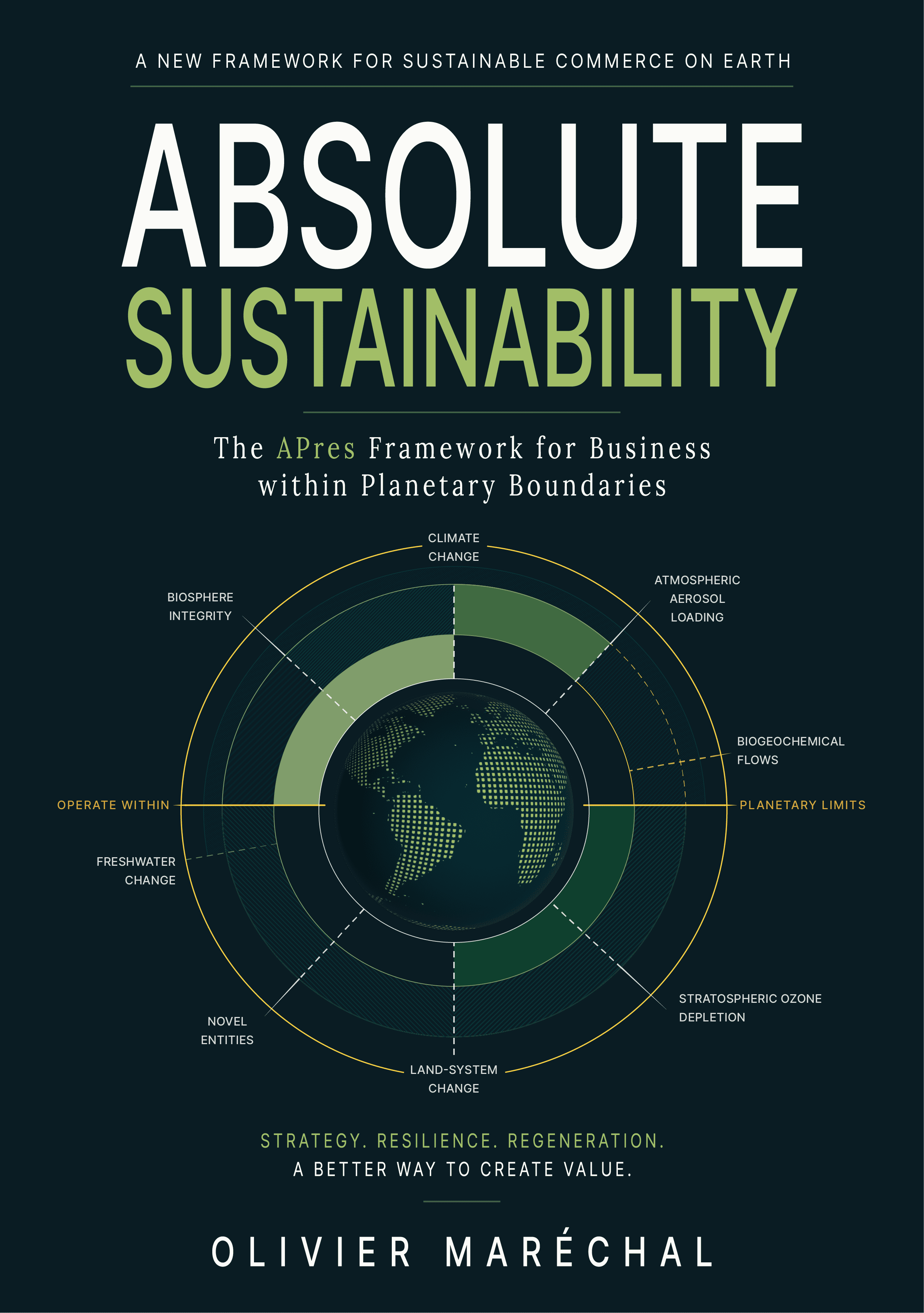
The paper summarises the logic and key aspects of the framework. The full technical reference is the forthcoming book, Absolute Sustainability.
References
White paper
Seven of the nine planetary boundaries are now transgressed, after three decades of corporate sustainability programmes. The paper argues that the cause is structural and the risk already material, and sets out the framework that inverts the order of the question: protect what must remain of each stock and flow first, then size use to it.
- Length
- 66 pages