ArticleValue Creation10 min read
Sustainability is a condition, not a strategy
Companies keep improving their impact intensity per unit sold while the natural stocks they depend on deteriorate. Closing that gap is a strategy problem, and no executive team can solve it from inside the building.

In brief
- Intensity targets can fall for years while total pressure on a shared natural stock rises.
- The cause is a frame: sustainability is placed in the future, measured as a flow and handled by one firm.
- Strategy that starts from what must remain, and is made with the people who share the stock, finds positions that rivals who treat limits as an annex cannot occupy.
Seven of the nine planetary boundaries are now crossed, according to the Potsdam Institute for Climate Impact Research's Planetary Health Check 2025.1 Global material extraction roughly tripled between 1970 and 2020, from about 31 to about 95 billion tonnes, according to the UN International Resource Panel's Global Resources Outlook 2024.2 Over the same decades, companies adopted targets, pledges and disclosures, and made each unit of output more efficient.
Effort went up, and so did the pressure. Lately the effort has become uneven. PwC's analysis of CDP disclosures found that 18% of companies lowered their climate ambitions in 2024–2025 while 23% raised them,3 and the Net Zero Tracker's 2025 stocktake recorded several oil, gas and financial firms weakening or dropping targets.4 It is tempting to read the pattern as fatigue or politics. We read it differently. The obvious explanations, too little ambition and too little technology, do not fit the evidence. What has stayed fixed is the frame in which the work is done.
That frame has three parts, and each looks reasonable on its own. Sustainability is placed in the future tense, as a risk that will arrive. It is measured as a flow, the impact per unit made or sold. And it is handled as a matter for the single firm. Wrong tense, wrong measure, wrong unit: together they keep the one condition that matters outside the strategy. A frame can be corrected, and doing so turns out to be a strategy question more than an environmental one. The rest of this piece takes the three errors in turn, then asks what a strategist does once they are fixed.
Wrong tense: the risk that never arrives
Take the materiality assessment, the process most large companies use to set sustainability priorities. Impact topics are scored for financial significance and stakeholder concern, ranked, and sorted into short, medium and long horizons. The method is orderly and repeatable. It also produces forecasts. A water-intensive site becomes a line in a 2030 target, not a question about whether its water source will support operations in 2030.
The horizon is not the flaw. The tense is. In the present tense we judge what is the case. In the future tense we weigh what could be. A condition that never enters the present becomes a forecast, and forecasts are discounted. Peter Senge described the underlying trap in The Fifth Discipline (1990) as a learning horizon: threats that build slowly sit beyond the span in which an organisation learns from feedback, so they are deferred, not denied.5
Framing the work as risk also gives it a shape. A risk is something to minimise, so sustainability settles into compliance (meet the target) or goodwill (hold the licence to operate). Both are defensible. Neither asks what the business should become. The strategy stays as it was, with a sustainability annex attached.
Wrong measure: the tap is not the level
Sustainability, in its plain meaning, refers to a limit. A flow is unsustainable only in relation to one. Think of a bath with a tap, a drain and a water level. The level rises whenever inflow exceeds outflow. Intensity metrics measure the tap. The limit is the level.
People misread this arithmetic, and not because they are careless. In a study reported in Science in 2008, John Sterman gave 212 MIT graduate students graphs of past emissions and concentrations and told them that emissions of carbon dioxide were roughly double the rate at which natural processes remove it. Even so, 84% drew patterns that broke the principles of accumulation.6 Cronin, Gonzalez and Sterman (2009) found that the error persists across text, tables and graphs, and that modest incentives did not cure it.7
Efficiency does not repair the misreading and often feeds it. Savings lower unit costs, widen the market and return as further output. William Stanley Jevons saw this in The Coal Question (1865): more efficient steam engines raised Britain's consumption of coal.8 Frederick Taylor saw it in shoes: in The Principles of Scientific Management (1911) he noted that machinery had cut their labour cost so far that households which once bought a pair every five years now bought one or two a year.9 Plastics show the same pattern at scale. Geyer, Jambeck and Law, writing in Science Advances in 2017, estimated that by 2015 the world had made about 8,300 million tonnes of virgin plastic and about 6,300 million tonnes of plastic waste. Of that waste, about 9% had been recycled and 12% incinerated. The other 79% sat in landfills or the natural environment.10 Product-level efficiency gains were probably real along the way. The total still went up.
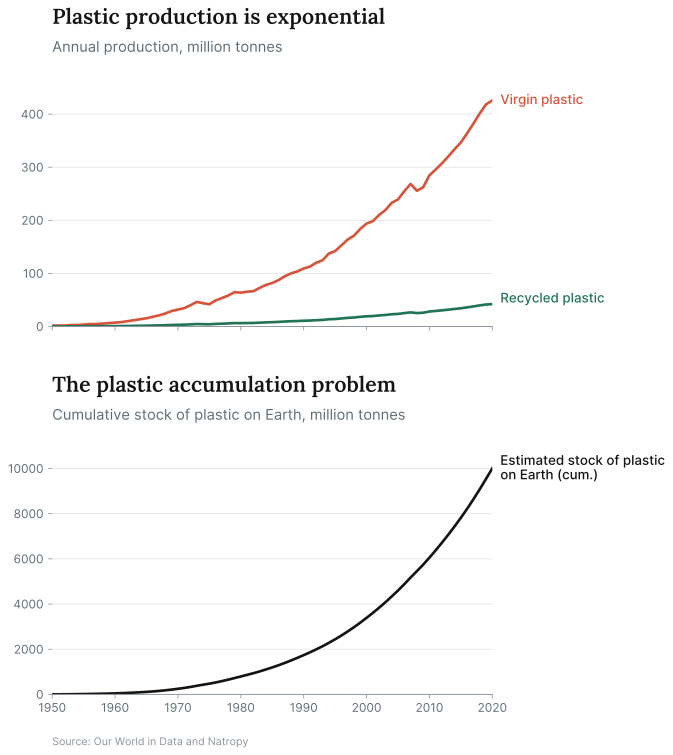
Annual production of virgin and recycled plastic, and the cumulative stock of plastic on Earth, in million tonnes.
Source: Our World in Data and Natropy
Allocating a share of the overshoot to each firm as an intensity target does not fix this. It freezes today's pattern of production, grows harder to meet as the economy grows, and gives a small producer inside its limits the same cut as a large one that dominates the total. Reduction still matters where the stock is fossil carbon, because a tonne not emitted is a tonne not added. But a target set against a company's own base year says little about the total, and less about how fast fossil energy is being displaced.
Wrong unit: no firm holds the stock
Consider a data centre. Meta reports that its water use effectiveness, litres per kilowatt-hour of IT load, improved by about 40% between 2020 and 2023, from 0.30 to 0.18. Its total water consumption rose by about 40% over the same years, from 2,202 to 3,078 megalitres (Meta Environmental Data Index, 2025).11 The efficiency was real, and the draw on the source still grew. Where the source is shared, the arithmetic turns local: in The Dalles, Oregon, Google's data centres used 355 million gallons in 2020, 29% of the city's water, according to records released in 2022 when the city settled its legal fight with The Oregonian over disclosure.12
A firm controls its own throughput. The condition of a shared stock is set by everyone's draw. So a company can lower its intensity and still add pressure to a stock that is past its limit. Its exposure does not shrink, because exposure is dependence on nature combined with the condition of the stocks depended on.
The dependence is large. In 2018 the Natural Capital Finance Alliance and UNEP-WCMC launched the ENCORE tool and showed that in 13 of the 18 sectors of the FTSE 100, $1.6 trillion in net market capitalisation was associated with production processes that depend highly or very highly on nature.13 The World Economic Forum and PwC (2020) put the global figure at about $44 trillion of economic value, more than half of world GDP, that is moderately or highly dependent on nature.14 Dependence alone is not risk. Dependence on a deteriorating stock or flow is.
Most sustainability strategies therefore aim at something the firm does not control, using a measure that cannot bind. That is a category error, not a weak strategy.
Strategise with the limit, not around it
Correcting the frame calls for an inversion: fix the level first, then size use to it. A well-run fishery sets the spawning stock before it sets the catch quota, and few executives would dispute that logic in that setting. Why does it stop there? Part of the answer is time discounting. A fishery collapse is an event people have already lived through.
Applied to a business, the inversion gives a present-tense test. The question is no longer whether the company is on a pathway to cut its intensity by some date. It is whether a given value proposition fits inside the space available now and, if not, whether it has a credible way of fitting. Any strategist applies this test to a binding constraint: either what we sell fits inside the sustainable space, or it assumes space that does not exist.
That moves the limit from the annex to the boundary conditions of the strategy. There is no separate sustainability strategy. There is strategy that delivers value without eroding the foundation of its own market, and strategy that captures value while eroding it, for as long as that lasts.
The difference shows in what each firm sees. A firm that strategises around the limits finds compliance costs and a growing list of things it can no longer do. A firm that strategises with them designs for them, and finds positions its rivals cannot readily occupy. This is where new business models come from. If the resulting strategy feels comfortable, and contains no credible story of how the status quo gets disrupted, it is probably not a strategy.
Open the strategy to those who share the stock
If the stock is shared, the strategy cannot be written by the executive team alone. Nobody inside the building knows how the aquifer, the supplier's watershed or the regulator's next move looks from outside, and nobody inside can change the level by themselves. Strategy-making itself has to change.
Call it opening the strategy: widening who takes part in work usually reserved for a small executive team. Opening has costs. It takes time, it needs clear rules about what stays confidential, and it disappoints the people invited if nothing changes as a result. For a shared stock the cost is worth paying, because the knowledge and the power the strategy is missing sit outside the building.
In practice that has a precise meaning. Bring in the people who see the stock from outside: the supplier whose watershed you draw on, the regulator drafting the next rule, the community on the same river, the scientist who can say where the limit sits. Give them a seat before the strategy is set, not a briefing after it. Outsiders also say what insiders will not. Ask them to build the case against your model, to think about how it can be disrupted, or how it can become irrelevant even, and treat what they find as the first draft of your strategy.
There is a harder reason too. A firm that pays to protect a shared stock competes against firms that do not, and the market rewards those rivals until it prices the difference. This is the oldest lesson in change management: change fails while the surrounding system still pays for the old behaviour. A company that acts alone in that position mostly loses ground. The firm that helps shape the rule, with the suppliers, peers and regulators who share the stock, can gain when the rule arrives. DuPont is a well-documented case. It made about a quarter of the world's CFCs and resisted limits until 1986, when it called for international controls. In 1988 it backed a full phaseout, once it had substitutes to sell, and Maxwell and Briscoe (1997) found that the regime opened 'new and more profitable chemical markets' for it.15 The same tool can be turned against the public interest. In 1965 the US tobacco industry helped secure a federal warning label so mild that it barred stronger rules until 1969.16 The test of any coalition is whether the rule it shapes brings the total down.
Five questions for the next strategy review
Five yes-or-no questions show where a strategy stands. They draw on APres™, the absolute sustainability framework developed by Natropy for business within planetary boundaries.
- Can you name, for each major line of business, the natural stock or flow whose condition limits its output first? It is usually land in agriculture and forestry, water in many data centres, and ore grade or water quality in mining.
- Have you written down what must remain of that stock before setting a target? Without an end state you can always reduce more and never know whether you are inside.
- Do you know which of your sources of competitive advantage the limit would erode, and whether the answer is to deepen the advantage, secure access, redesign the offer or exit/diversify?
- Does any metric in your reporting test the present gap to a fixed limit in absolute terms, rather than a flow, a trajectory or a peer comparison? If none does, the report describes how fast the bath is filling, from an inward firm-centric perspective, not how full it is.
- Has anyone outside the executive team, from a supplier to a regulator to a local community, shaped your answer to any of these?
An important question in front of any board is whether the long-term strategy of the company embraces environmental boundary conditions or ignores them and leaves them in the annex.
References
-
Potsdam Institute for Climate Impact Research. Planetary Health Check 2025: A Scientific Assessment of the State of the Planet. Published 24 September 2025. https://publications.pik-potsdam.de/pubman/faces/ViewItemFullPage.jsp?itemId=item_32589_2 ↩
-
UN International Resource Panel. Global Resources Outlook 2024. Published 1 March 2024. Extraction rose from 30.9 billion tonnes in 1970 to 95.1 billion tonnes in 2020. https://www.resourcepanel.org/news-events/global-resources-outlook-2024-press-release ↩
-
PwC. Third Annual State of Decarbonization Report, based on CDP disclosures, 2026. ↩
-
Net Zero Tracker, NewClimate Institute, Oxford Net Zero, Energy & Climate Intelligence Unit and Blavatnik School of Government. Net Zero Stocktake 2025. Published 23 September 2025. https://zerotracker.net/analysis/net-zero-stocktake-2025 ↩
-
Senge PM. The Fifth Discipline: The Art and Practice of the Learning Organization. New York: Doubleday; 1990. ↩
-
Sterman JD. Risk communication on climate: mental models and mass balance. Science. 2008;322(5901):532–533. doi:10.1126/science.1162574 ↩
-
Cronin MA, Gonzalez C, Sterman JD. Why don't well-educated adults understand accumulation? A challenge to researchers, educators, and citizens. Organizational Behavior and Human Decision Processes. 2009;108(1):116–130. doi:10.1016/j.obhdp.2008.03.003 ↩
-
Jevons WS. The Coal Question. London: Macmillan; 1865. ↩
-
Taylor FW. The Principles of Scientific Management. New York: Harper & Brothers; 1911. pp. 17–18. ↩
-
Geyer R, Jambeck JR, Law KL. Production, use, and fate of all plastics ever made. Science Advances. 2017;3(7):e1700782. doi:10.1126/sciadv.1700782 ↩
-
Meta. 2025 Environmental Data Index. Water use effectiveness 0.30 (2020) and 0.18 (2023) litres per kilowatt-hour; total water consumption 2,202 and 3,078 megalitres. ↩
-
Associated Press. The Dalles, Oregon: Google data-centre water use disclosed after the city settled with The Oregonian. 15 December 2022. https://apnews.com/article/technology-business-oregon-the-dalles-climate-and-environment-f63f313b0ebde0d60aeb3dd58f51991c ↩
-
Natural Capital Finance Alliance and UNEP-WCMC. New tool allows financial institutions to see their exposure to natural capital risk (ENCORE launch). 26 November 2018. https://www.unep-wcmc.org/en/news/groundbreaking-new-tool-allows-financial-institutions-to-see-their-exposure-to-natural-capital-risk ↩
-
World Economic Forum, in collaboration with PwC. Nature Risk Rising: Why the Crisis Engulfing Nature Matters for Business and the Economy. January 2020. ↩
-
Maxwell J, Briscoe F. There's money in the air: the CFC ban and DuPont's regulatory strategy. Business Strategy and the Environment. 1997;6(5):276–286. ↩
-
Federal Cigarette Labeling and Advertising Act of 1965, Public Law 89-92. Enacted 1 July 1965. ↩